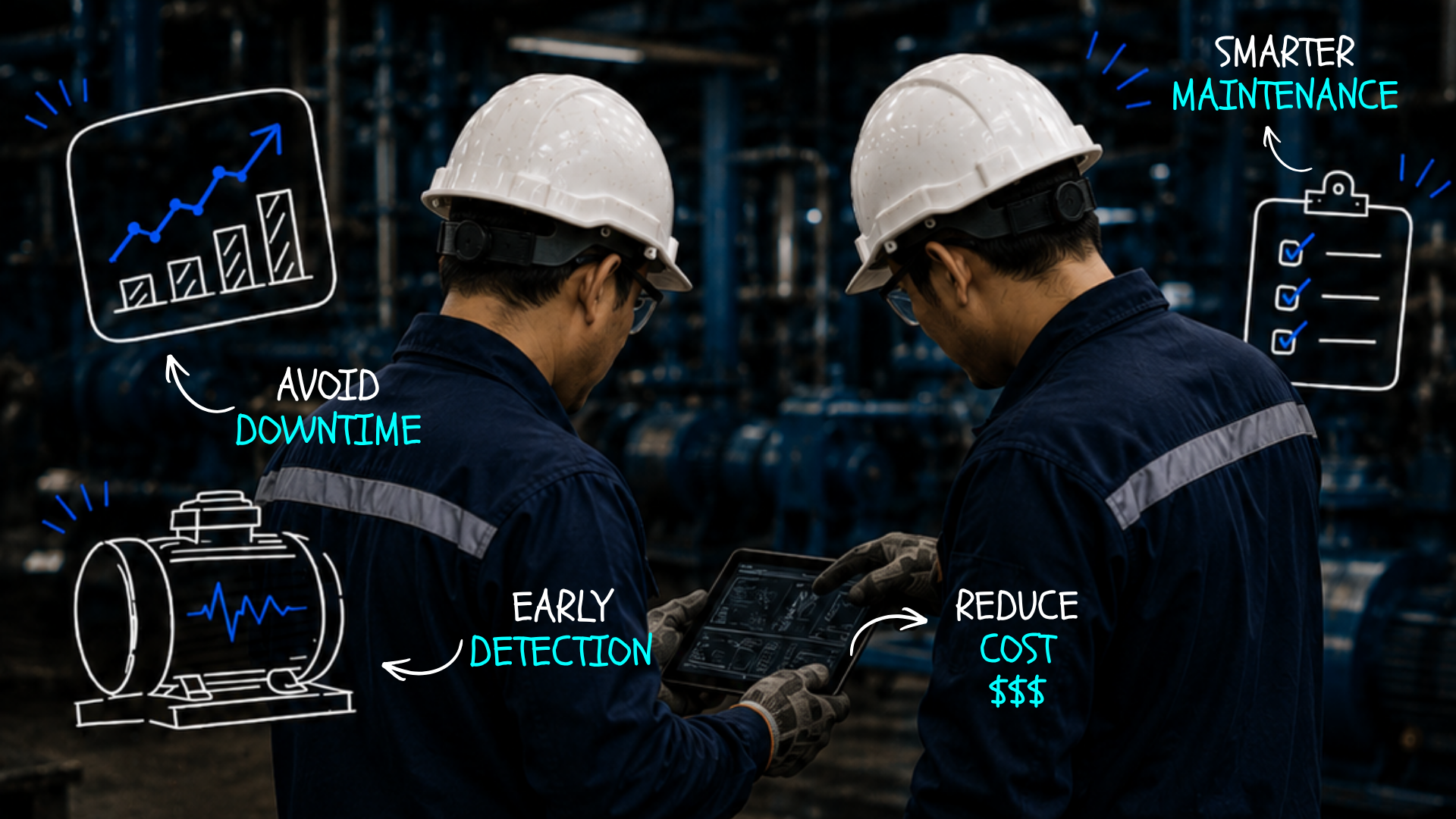
Downtime rarely announces itself. It starts as a signal almost nobody is positioned to catch: a motor drawing a little more current, a bearing whispering at its defect frequency, a pump running a degree warmer than its neighbour. Hours or weeks later, that quiet signal becomes a stopped line, a lost shift, and a team scrambling to recover. The whole promise of AI predictive maintenance is to catch the whisper, not just clean up after the bang.
For the maintenance managers and operations leaders who carry the uptime number, the stakes are blunt. Unplanned downtime can cost a manufacturer on the order of USD 260,000 an hour, and in critical infrastructure, water, energy, transport, the cost is measured in communities affected, not just output lost. Done right, AI predictive maintenance can cut unplanned downtime by up to 50 percent. Here is how it actually gets there.
Step One: Turn Machine Health into Data
Prevention starts with visibility. Sensors on an asset capture its vibration, acoustic, motor-current, temperature, and process data continuously, converting the physical behaviour of a machine into a live stream a system can reason over. This is machine health monitoring, and it is the raw material for everything that follows. Without it, a team is inspecting on a calendar and hoping nothing fails in between.
Step Two: Learn What Healthy Looks Like, Per Asset
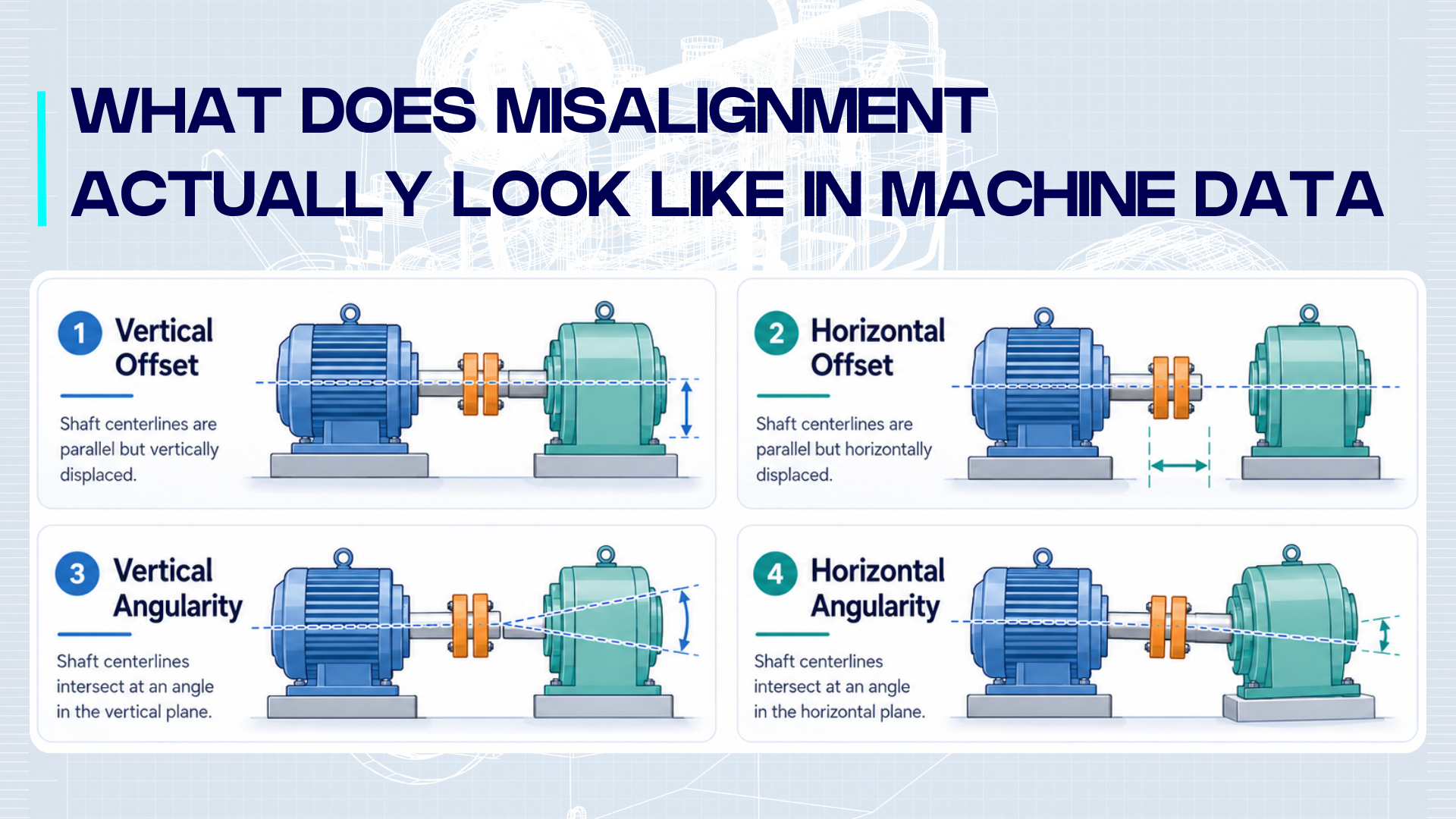
Data alone does not prevent anything. The intelligence is in the baseline. AI learns the normal operating signature of each specific machine, then watches for the early deviations that precede failure. This is where generic tools stumble, because two identical machines do not share a signature once foundation, alignment, and load diverge. A per-asset baseline is what separates real predictive analytics from a fixed threshold that either cries wolf or stays silent while a defect grows underneath it.
Step Three: Detect the Deviation Early
Every failure has a runway. The P-F interval is the window between the first detectable sign of a potential failure and the point of functional failure. Fixed-threshold alarms tend to fire late in that window, when the value finally crosses a limit and you have little time left. AI predictive maintenance detects the deviation early, near the top of the curve, which is exactly where you still have options. Early detection is what converts a mid-shift emergency into a planned job.
Step Four: Diagnose the Failure Mode and Root Cause
Detecting that something changed is not the same as knowing what is wrong. A threshold crossing tells you a value is high. It does not tell you a seal is weeping, a valve is leaking, a bearing is spalling, or a pump is cavitating. Diagnosis is what makes an alert actionable, because a team that knows the failure mode knows what parts, people, and time the fix will take. This is the difference between software that predicts and software that reasons.
Step Five: Estimate Remaining Useful Life
Knowing what is failing is powerful. Knowing how long you have is what protects the schedule. By estimating remaining useful life against the P-F interval, AI predictive maintenance lets a team place the repair in the next planned window rather than reacting to a breakdown. This is where the unplanned downtime reduction actually shows up, because the failure never becomes unplanned in the first place.
Step Six: Guide the Action, in Real Time
The last step is the one most platforms skip. Real-time monitoring only prevents downtime if the insight reaches a person who can act, with a recommendation they can trust. Cognitive Maintenance carries every reading all the way to a confident, asset-specific action in the hands of the operator, not just another alert on a dashboard. Reason, diagnose, guide, not just detect. That final mile is where asset reliability is won or lost.
Why This Matters Most for Mission-Critical Assets
In a factory, prevented downtime protects a P&L. In critical infrastructure monitoring, it protects something less forgiving. A water pump station, a power asset, or a transport system cannot be taken offline to inspect, and a failure ripples straight into public service. These operations are vast fleets of rotating equipment that run continuously, which is exactly where early, trustworthy prediction earns its keep. Preventing one failure is not a maintenance win. It is a service that never went down.
AI predictive maintenance prevents downtime not through any single sensor, but through a chain: sense the machine, baseline it individually, detect early, diagnose the cause, estimate the runway, and guide the action in time. Break the chain at the alert, and you have monitoring. Carry it to the action, and you have prevention. The world’s leading asset-heavy operators are already moving past predictive alerts and toward machines that reason. Are you?