In today’s fast-changing manufacturing world, quality control matters the most. One defect can result in costly recalls, production stops, or safety dangers. Human inspectors have managed this job for years, but now Artificial Intelligence (AI) is showing better speed, accuracy, and consistency in catching problems early.
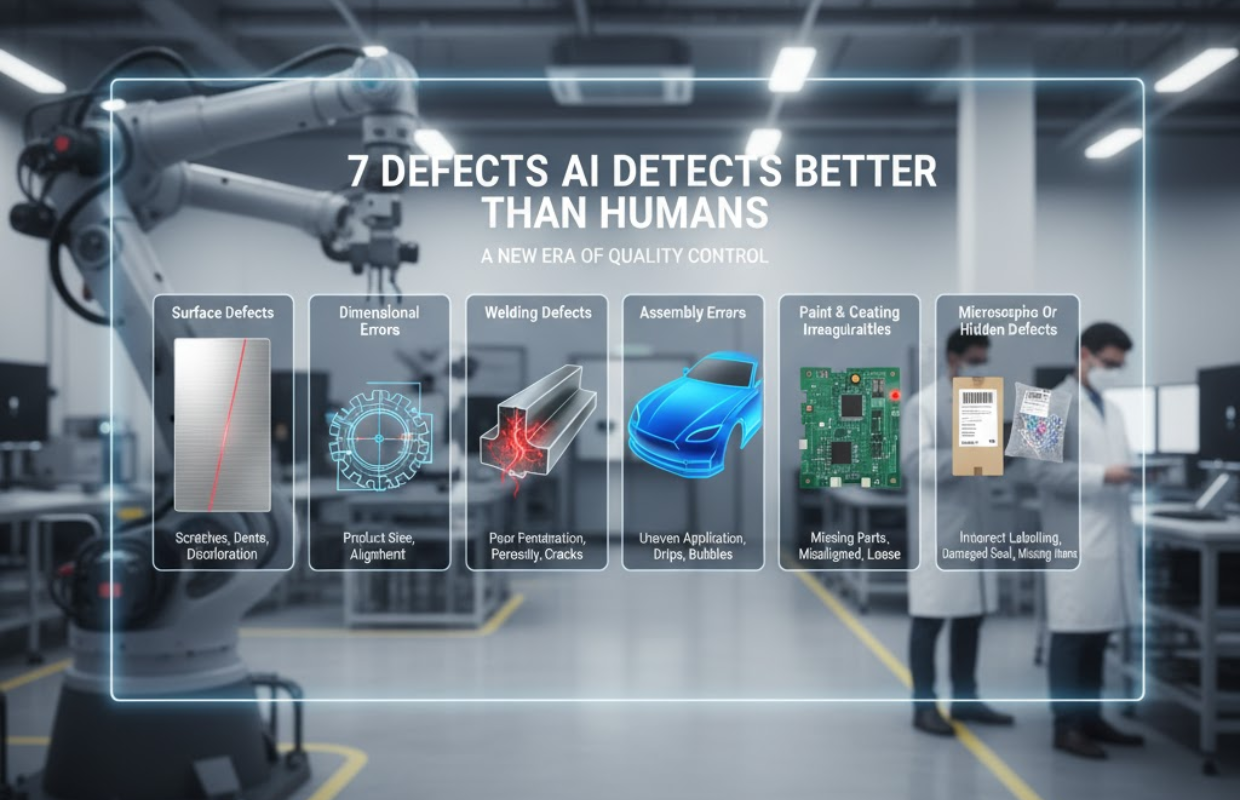
AI inspection systems can review thousands of photos per minute, catch tiny mistakes, and work all the time without a break. In this blog, we’ll talk about seven types of defects that AI can detect better than humans and why more companies are using it for better quality control.
1. Surface Defects
One of the most common uses of Artificial Intelligence(AI) in inspection is detecting surface defects such as:
- Scratches
- Dents
- Cracks
- Discoloration
In many industries, especially in automotive, electronics, and metal manufacturing, even a small surface flaw can affect the quality of the final product. AI, on the other hand, uses computer vision to inspect surfaces pixel by pixel. It checks the image against thousands of perfect ones to find even the slightest difference. This leads to quicker detection, fewer errors, and stronger product quality.
2. Dimensional Errors
In areas where exact measurements matter, such as making machine parts, precision is very important. Humans can use tools to measure, but it’s slow and errors often occur. AI systems using 3D scanners or laser tools can check on their own:
- Product size and shape
- Alignment and symmetry
- Thickness and spacing
AI tools quickly find issues like uneven edges, poor cuts, or design mistakes. This makes sure every product stays consistent and helps save materials from being wasted.
3. Welding Defects
Welding points can be the weakest spots in machines, pipelines, and vehicles. Issues like poor penetration, tiny holes, or cracks can make them weaker and cause safety risks.
Traditionally, experts used visual checks or X-ray scans to inspect welds. Today, AI improves this process. With deep learning, it can review welding images or videos in real time and catch tiny defects better than human eyes.
AI welding inspection systems can notify operators at once, allowing them to correct errors during production instead of later. This early check saves time, money, and hard work.
4. Paint & Coating Irregularities
Paint flaws might look minor, yet they can harm a product’s look and strength. Some usual coating problems are:
- The paint was not applied evenly
- Drips or small bubbles
- Missed areas
- Dust mixed in the paint
While humans judge by sight, AI uses detailed cameras and pattern models to look at color, surface, and gloss. It can find problems invisible to the eye, especially on large assembly lines, like in electronics or cars. This ensures products come off the factory floor with perfect finishing every single time.
5. Assembly Errors
Even with automation, assembly problems happen. Loose parts, missing screws, or misaligned components may look small but can cause big trouble for the customer. AI-based vision tools can track the assembly line in real time, making sure every stage is correct. For example:
- Ensuring parts are properly fitted
- Verifying components are in the right position
- Checking for missing elements
AI performs nonstop without needing rest, lowering human errors. With such systems, industries can maintain steady quality and sharply cut rework or recall expenses.
6. Packaging Defects
Before a product reaches customers, packaging is the final step and plays a key role in safety and brand image. AI can detect packaging defects such as:
- Incorrect labeling or barcodes
- Damaged seals
- Missing items
- Misaligned prints
AI inspection cameras scan packages fast and flag issues. This ensures every product is safe, professional, and ready to ship. In areas like food, pharmaceuticals, or beauty products, where regulations are tough, AI inspections bring more trust and control.
7. Microscopic Or Hidden Defects
Tiny or deep defects can be invisible to humans, even trained inspectors. AI using infrared, X-ray, or ultrasonic scanning can detect cracks, holes, or impurities inside materials.
This matters most in industries such as aerospace, electronics, and medical equipment manufacturing, where accuracy and strength are needed.
Why AI Outperforms Humans
AI makes human inspection quicker, more precise, and reliable. It can:
- Inspect hundreds of items per minute without fatigue
- Catch tiny defects even humans might miss
- Keep the same focus all the time
- Cut down waste and rework, saving money
- Work across different products and environments
AI does not replace humans but gives them time for smarter jobs like decision-making and quality work.

The Future Of AI Inspection
Future AI will not only find defects but also predict them. It looks at production data and offers steps to prevent issues. This helps industries act before problems occur. Self-learning systems improve with every scan, making processes more accurate and efficient.
Final Thoughts
AI is improving industrial quality control, catching defects faster and better than humans. With Groundup.ai, companies can inspect smarter, faster, and with more trust. Find out how AI can ensure perfect quality in every product today.