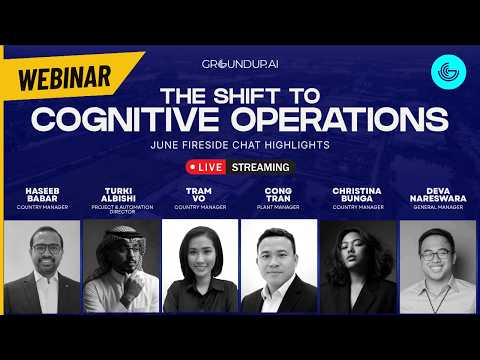
Indonesian manufacturing does not have a hardware problem. It has a foresight problem. As one Indonesian plant leader told us, maintenance stays reactive while production keeps getting pushed harder and more aggressively. The line runs hot, the orders keep coming, and the failures still arrive without warning. IoT predictive maintenance exists to change that. But how it helps, and where it stops helping, is worth understanding before you buy.
Why This Matters for Making Indonesia 4.0
Manufacturing is the engine of the economy here, contributing around 20 percent of GDP and employing more than 18 million people. Under the Making Indonesia 4.0 roadmap, the government is pushing factories toward smart manufacturing, and the industry is responding: around 80 percent of manufacturers plan to put more than a fifth of their improvement budgets into technologies like sensors, analytics, and cloud. This is a signal. The question for a maintenance leader is no longer whether to adopt IoT predictive maintenance, but how to choose a platform that actually reduces downtime rather than adding another dashboard.
How IoT Predictive Maintenance Works
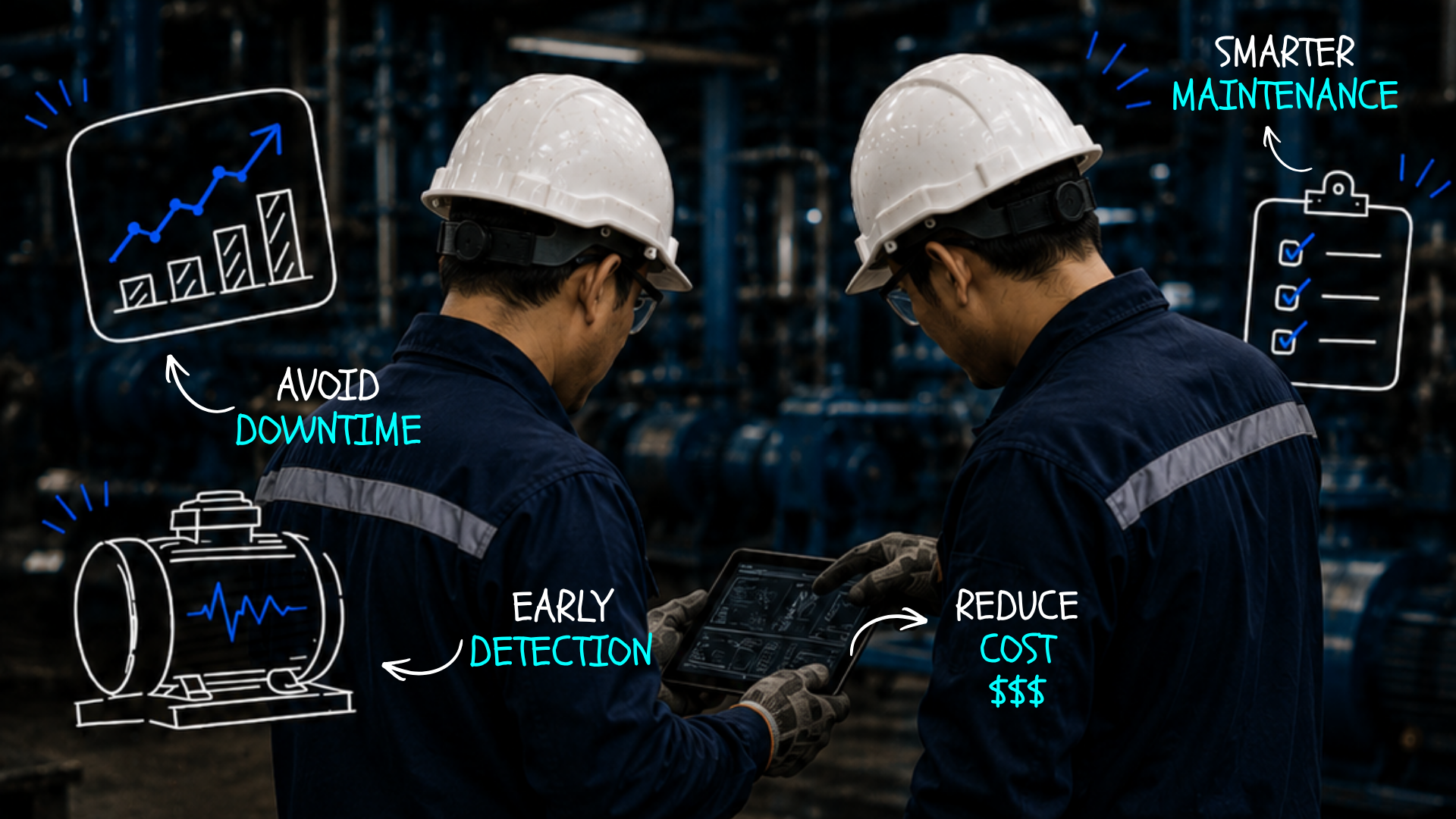
The mechanics are straightforward. IoT sensors mount on your critical machines and stream their vibration, acoustic, motor-current, temperature, and process data continuously. Analytics learn what normal looks like for each asset, and AI flags the early deviations that come before a failure, a bearing beginning to spall, a seal weeping, a pump edging into cavitation. Caught early, a breakdown becomes a planned job with the right parts and people, instead of a 1am scramble. That is the promise, and on the right platform it holds.
Where IoT Alone Runs Out of Road
Here is the part most vendors will not tell you. IoT is the on-ramp, not the destination. A sensor is very good at telling you a value changed. It is far weaker at telling you what is wrong, how urgent it is, and what to do next. Two identical machines do not even share a signature once foundation, alignment, and load diverge, so a platform built on generic thresholds and raw IoT data floods your team with false alarms until they stop trusting it. Collecting data is not the same as understanding it.
This is exactly why Groundup.ai is more than IoT. Our core is not the sensor. It is the Groundup.ai Asset Library.
The Groundup.ai Asset Library: What Makes it Cognitive Maintenance
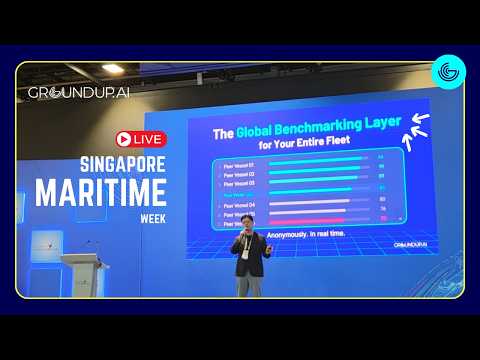
The Groundup.ai Asset Library is the accumulated machine intelligence behind every reading. It holds the health signatures, failure modes, and baselines of machinery seen across fleets, plants, and sectors, so when your pump or compressor starts to deviate, the system does not just notice a change. It recognises the pattern, names the likely failure mode, and benchmarks your asset against how that machine behaves in the wider world. Think of it as the difference between a smoke detector and an experienced engineer who has heard that exact noise a thousand times.
That is what turns IoT data into Cognitive Maintenance: machines that reason, diagnose, and guide, rather than just alert. The IoT sensor gathers the signal. The Asset Library gives it meaning. And the output is a specific recommended action in the hands of the operator, not another number to interpret alone.
What Indonesian Plant Buyers Should Evaluate
If you are comparing IoT predictive maintenance platforms, look past the sensor spec sheet and ask what sits behind it. Does the platform build a baseline for each machine, or apply one generic threshold? Does it diagnose the failure mode and root cause, or just raise a flag? Does it draw on a wider library of machine knowledge, or only your own limited history? Does it estimate remaining useful life so repairs become planned work? And does it end in an action your team can act on, integrated with the systems you already run? The platforms that answer yes are the ones that escape the pilot trap and scale across the plant.
The best proof is a small one. As another Indonesian leader put it, you start small and build trust among your coworkers until the solution becomes a standard that helps. That is how adoption actually happens on the floor: one line, one visible win, then scale.
P.S. If your current tools generate more alerts than answers, the missing piece is not more sensors. It is the intelligence that tells you what the sensors mean.