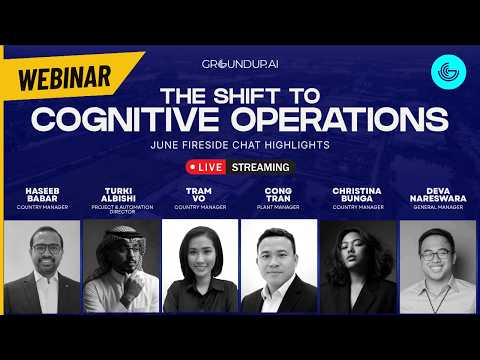
Ask a Saudi plant manager about their worst week and the story almost always starts the same way: at night. A line goes down without warning, the right spare is not on the shelf, and a team gets pulled out of bed to diagnose a failure in the dark. As one manufacturing leader in the Kingdom put it in a recent Groundup.ai fireside chat session, an unplanned breakdown is simply a nightmare, and the worst ones always come at night.
That is the reality predictive maintenance is meant to change. But there is a wide gap between the promise of AI on a slide and what actually reduces unplanned downtime on a Saudi factory floor. This guide is for the maintenance and operations leaders trying to tell one from the other.
Why This Matters Now, in the Kingdom
The timing is not an accident. Under Vision 2030, Saudi Arabia is rebuilding its industrial base around smart factory solutions, and the money is following. The Kingdom’s smart manufacturing market is projected to grow from around USD 3.8 billion in 2025 to nearly USD 11.9 billion by 2034, a compound annual growth rate above 13 percent, as manufacturers pour investment into automation, industrial IoT, and AI.
The cost of standing still is just as concrete. For a typical Saudi industrial facility, a single day of unplanned downtime can cost between SAR 500,000 and SAR 2 million, and in poorly optimised plants, downtime eats 5 to 20 percent of production capacity. Every minute a critical asset is stopped lands directly on the P&L. This is a signal. Predictive maintenance in Saudi manufacturing is no longer a pilot-project curiosity. It is an operational and financial priority.
How AI-Powered Predictive Maintenance Actually Works
Strip away the buzzwords and the idea is simple. Sensors on a machine capture its vibration, acoustic, motor-current, temperature, and process data continuously. AI learns what healthy looks like for that specific asset, then watches for the early deviations that precede failure, a bearing beginning to spall, a seal starting to weep, a compressor valve leaking, a motor drawing current it should not.
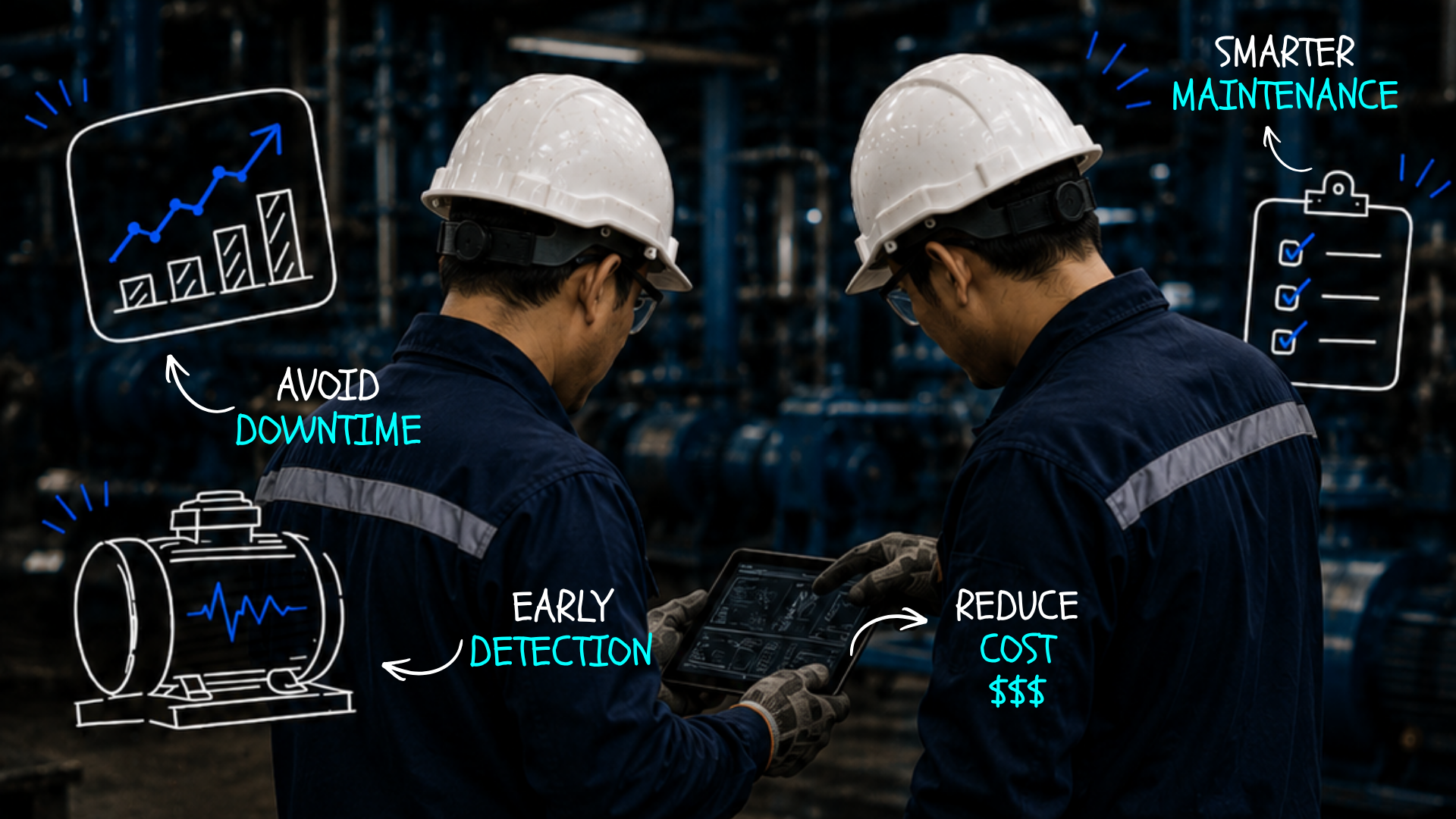
Done well, it moves a team from reacting to a breakdown to planning around it. Instead of discovering a failure at 2am, you get weeks of warning, so the repair becomes a scheduled job with the right parts and people. That is the whole game: turning a nightmare at night into a task on a Tuesday.
Why Predictive Maintenance Programs Fail in Factories
Here is the uncomfortable part. Many programs are bought, deployed, and quietly ignored within a year. The reasons are consistent, and they have almost nothing to do with the sensors.
The first is false alarms. Most tools run on fixed thresholds, and fixed thresholds do not understand machinery. Two identical machines, same make and duty, do not share a signature once foundation, alignment, and load diverge. A generic alarm nuisance-trips on one and stays silent on the other while a real defect grows underneath. Run that across a plant and, as another Saudi manufacturing leader observed, you are overwhelmed by the noise and the vibration, with data scattered everywhere. Operators learn to ignore the very system meant to protect the line. The alert volume goes up. The trust goes down.
The second is the gap between an alert and an action. A threshold crossing tells you a value is high. It does not tell you the failure mode, the root cause, or what to do before the machine stops. And people cannot close that gap by working harder. As the same leader noted, humans are very intelligent beings, but their understanding, reflection, and reaction takes time. When the plant depends on one veteran engineer to interpret every reading, the program is one resignation away from collapse.
The third is treating this as a technology purchase instead of a trust-building exercise. The first step is not a platform decision. It is knowing what your machines are already telling you on one line, and earning trust from a result the team can see.
What Saudi Plant Teams Should Look For
If you are evaluating AI maintenance platforms, judge them on how few and how trustworthy their alerts are, not how many. In practice that means: per-asset baselines rather than fixed thresholds; diagnosis of the failure mode and root cause, not just detection; an estimate of remaining useful life so repairs become planned work; a specific recommended action in the operator’s hands; and fit with the systems and sensors you already run rather than a rip-and-replace.
The distinction that matters is between software that predicts and software that reasons. Legacy predictive maintenance stops at the alert. Groundup.ai’s Cognitive Maintenance carries the reading all the way to a confident, asset-specific action, which is exactly what separates a maintenance failure analysis you can act on from a dashboard nobody opens.
Proof Beats Promises
None of this is theoretical in the region. In Saudi Arabia, a single early catch on one pump saved a Coca-Cola facility USD 243,000. That is what happens when the system does not stop at the warning but carries it to a decision the team acts on in time. What wins a floor team over is never the mandate. It is the first time the system catches something their spreadsheet missed.
Make the Shift Today
The shift from reactive to Cognitive Maintenance is not really a technology decision. It is about culture, trust, and the willingness to let data lead the decision. Saudi Arabia is already investing to build the smart factories of Vision 2030. The plants that pull ahead will be the ones that choose predictive maintenance that diagnoses, prioritises, and guides, so every riyal of maintenance budget and every hour of crew time lands on the asset that needs it most.