Ask any water utility operations leader what keeps them up, and it is rarely the asset they are watching. It is the pump station at 2am that nobody is watching, the one that trips and takes a suburb’s supply or a lift station’s containment with it. By the time the SCADA alarm fires, the crew is already in the truck, and the failure is already a cost.
That gap, between the moment an asset starts to fail and the moment anyone can act on it, is the real problem AI predictive maintenance software exists to close. This guide is for the water utility maintenance and operations leaders deciding what to buy, and how to tell substance from noise.
Why Asset Performance is Now a Board-Level Issue for Water Utilities
The pressure is structural, and the numbers are stark. Nearly 80 percent of water utility stakeholders name ageing infrastructure as the single hardest issue facing the industry, with pipes and pumping assets installed in the 1960s and 1970s now running well beyond their design life. The median water main experiences more than 12.7 breaks per 100 kilometres a year, and each failure drives up pumping energy, accelerates wear on nearby assets, and burns emergency-callout budget.
Energy makes it sharper. Australian water utilities (for example) consume roughly 13,000 gigawatt-hours of electricity a year, and energy can account for up to 40 percent of a utility’s operating budget, with pumping taking the lion’s share. A pump running toward failure is not just a reliability risk. It is quietly burning money on every cycle.
The sector has read the signal. Australia’s digital water spend is forecast to more than double from around USD 959 million in 2026 to USD 2.4 billion by 2036, a 9.6 percent annual growth rate, and utilities like Melbourne Water have put multi-billion-dollar renewal programs on the table. The world’s leading water utilities are moving past reactive infrastructure management and toward predictive analytics that guide the decision. The question is no longer whether to invest in AI predictive maintenance software. It is which software actually improves asset performance management, and which just adds another dashboard.
Where Most Predictive Analytics for Water Utilities Stops Short
Here is the trap. Most tools sold as predictive analytics are built on fixed thresholds and anomaly flags. They are very good at telling you a parameter has moved. They are far weaker at telling you what is wrong, how urgent it is, and what to do next.
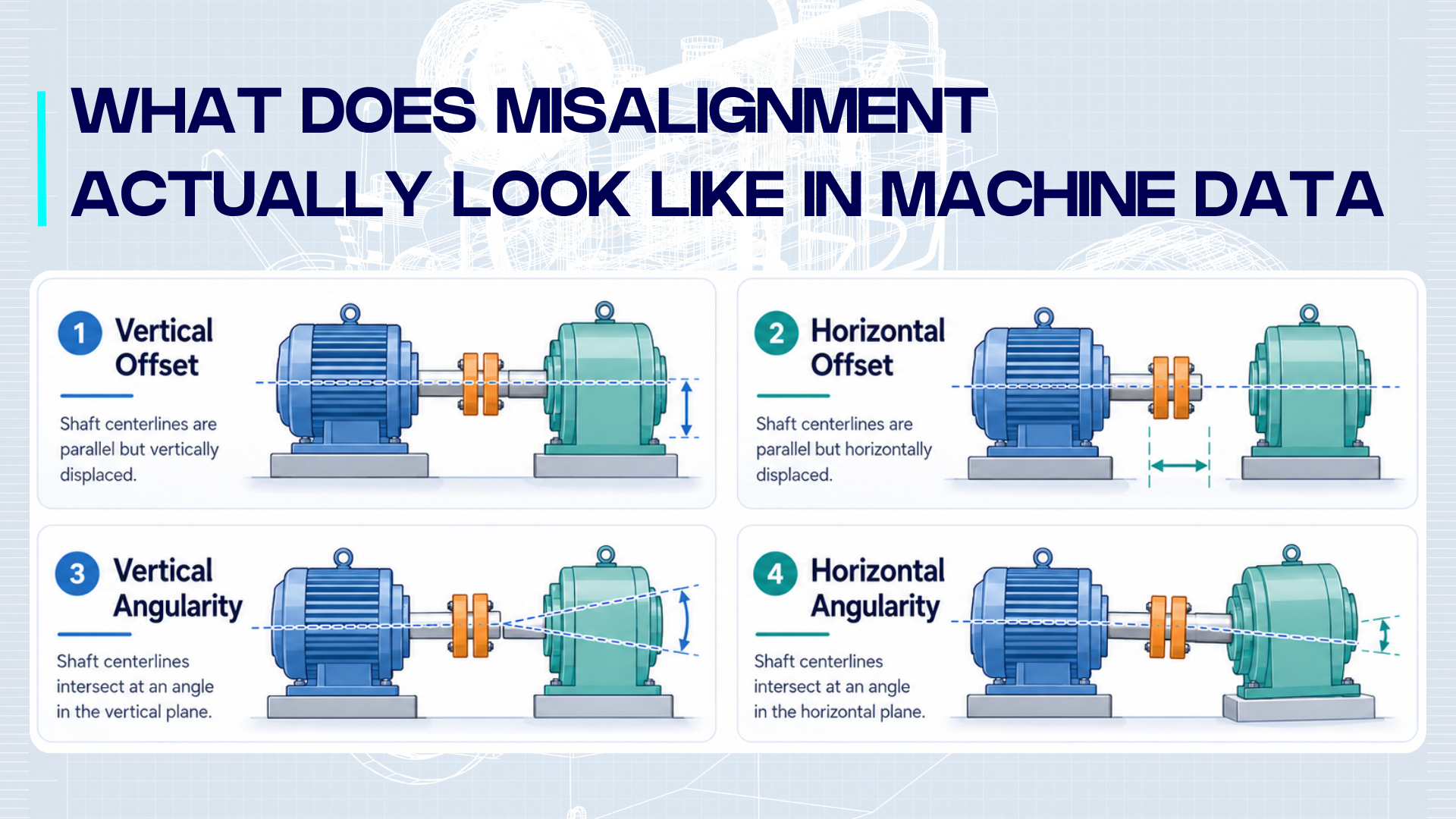
Two identical distribution pumps, same make, same duty, do not share a vibration or current signature once foundation, alignment, and duty cycle diverge. A generic alarm tuned for one will nuisance-trip on the other, or stay silent while a real bearing defect grows underneath the threshold. Multiply that across a network of pump stations and lift stations and your team drowns in amber alerts that mean nothing, which is precisely how experienced operators learn to ignore the system meant to protect the network. The alert volume goes up. The trust goes down.
An alert that says vibration is high does not tell you a bearing is spalling at its defect frequency, that a mechanical seal is weeping, or that a pump is cavitating. It does not estimate how far along the P-F interval you are, the window between a detectable warning and functional failure. And it does not tell the operator what to actually do before the asset goes down. That is the action gap, and it is where a lot of water utility infrastructure maintenance spend quietly underdelivers.
What to Look for When You Evaluate AI Predictive Maintenance Software
If you are evaluating tools for water utility management, judge them less on how many alerts they generate and more on how few, and how trustworthy. A short checklist that separates real capability from a monitoring dashboard:
- Per-asset baselining, not fixed thresholds. Does the software model each pump and motor on its own operating signature, or apply one generic limit across assets that are not actually identical?
- Diagnosis, not just detection. When something changes, does it isolate the failure mode (bearing, seal, cavitation, valve) and the likely root cause, or just raise a flag?
- Remaining useful life (RUL) against the P-F interval. Can it tell you how long you realistically have, so a repair becomes a planned job in a maintenance window rather than an emergency callout?
- A recommended action, in the operator’s hands. Does it close the last mile and tell the crew what to do, or leave interpretation to whoever is on shift?
- Asset performance management across the fleet. Does it rank where attention is most needed across every station, so scarce crews and CAPEX go to the assets that matter?
- Fit with existing SCADA, GIS, and sensors. Does it layer onto the infrastructure you already run, rather than demanding a rip-and-replace?
The distinction that matters is the one between software that predicts and software that reasons. Legacy predictive maintenance stops at the alert. Groundup.ai’s Cognitive Maintenance carries the reading all the way to a confident, asset-specific action, so your team spends its time fixing the right asset at the right time, not triaging a wall of warnings.
How this Plays out on Real Water Utility Assets
Water utilities are, at their core, vast fleets of rotating equipment. Raw-water and high-lift pumps, distribution and booster pumps, wastewater lift stations, aeration blowers, and the motors driving all of them. These are exactly the assets Cognitive Maintenance is built to read.
On a distribution pump, health lives in the bearing defect frequencies, cavitation signatures, and current draw. Caught early, it is a planned seal or bearing swap. Caught late, it is a failed impeller, an unplanned outage, and a spike in pumping energy while the network compensates. On a wastewater lift station, a degrading pump risks a containment event with regulatory and community consequences that dwarf the repair cost. The value is never the sensor reading. It is that the system carries that reading to a specific action in the hands of the crew, before the failure becomes a headline.
This is the layer our Groundbreakers work at, on site with operators, turning signals into decisions the team can trust.
The Next Wave of Water Utility Infrastructure Maintenance is Already Here
The shift from reactive to Cognitive Maintenance is not really a technology decision. It is about culture, trust, and the willingness to let data lead the decision, in the pump house as much as in the boardroom.
Australian water utilities are already investing to modernise ageing networks and cut the cost of failure. The utilities that pull ahead will be the ones that choose AI predictive maintenance software that does more than predict, that diagnoses, prioritises, and guides, so every maintenance dollar and every crew hour lands on the asset that needs it most.