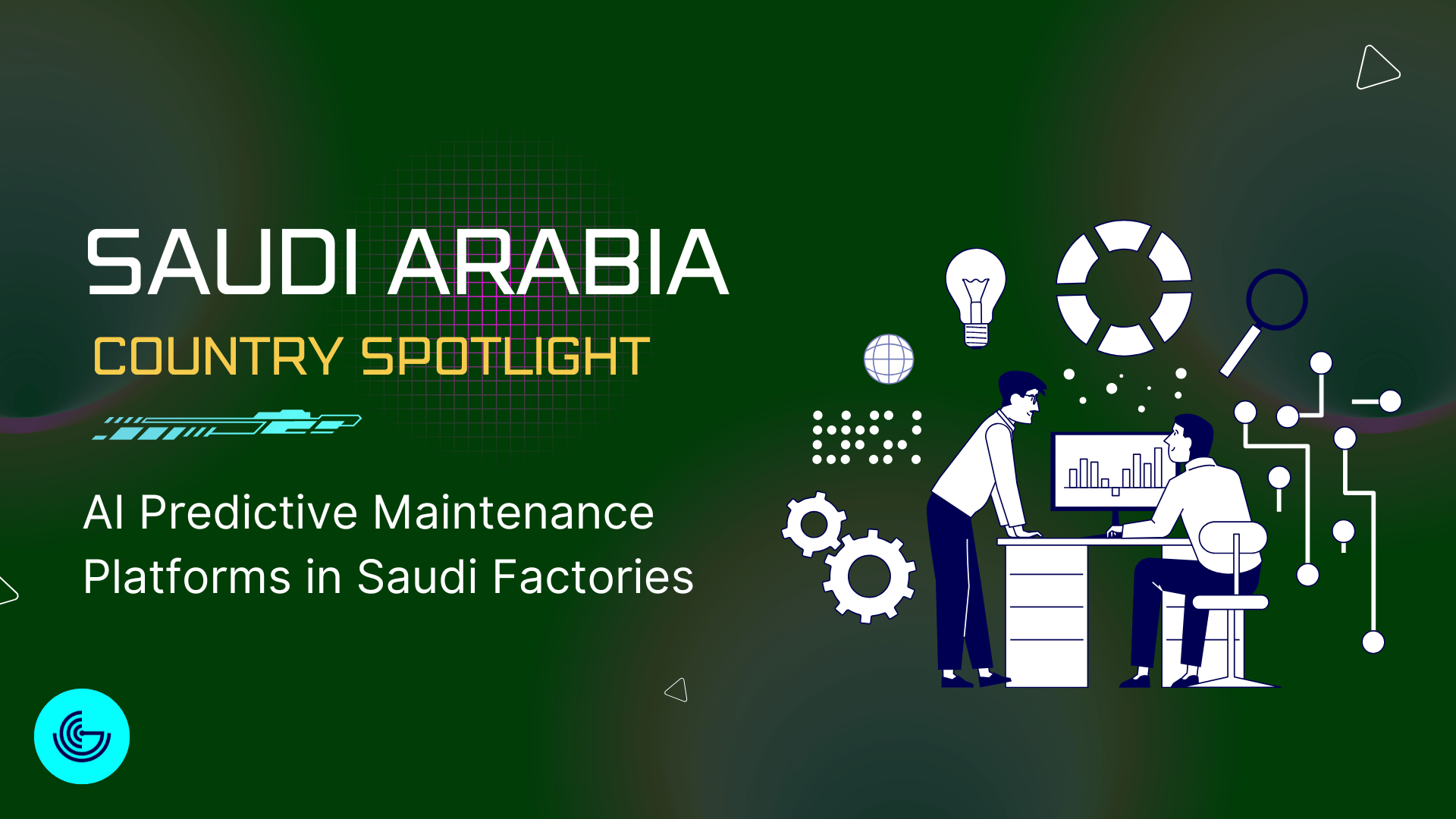
As Saudi Arabia marks 2026 as its official Year of Artificial Intelligence under the digital transformation mandates of Vision 2030, industrial automation across the Kingdom has moved past standard digitisation. Plant managers and operations leaders throughout Riyadh, Jubail, Yanbu, and Jeddah are actively replacing legacy checking routines with high-performance predictive maintenance solutions.
However, selecting an AI maintenance platform requires evaluating more than high-level analytics. A misaligned procurement choice can result in a stalled deployment that traps data in isolated dashboards without improving factory floor uptime.
This guide provides a structured, practical evaluation framework to help Saudi factory leaders audit and compare factory maintenance solutions across five critical operational vectors.
Quick Summary: Industrial Procurement Standard
How do you accurately evaluate an AI predictive maintenance platform?
Prioritise software that integrates non-invasive, multi-modal hardware directly into your local network architecture, and features a deep library of pre-trained subcomponent signatures to eliminate long startup times. The resulting data insights must link via direct APIs to your active work tracking software to automate repair workflows out of the box.
1. Integration Fit: Brand-Agnostic vs. OEM Ecosystems
Saudi manufacturing environments frequently feature a varied mix of production assets. A single packaging line, milling station, or heavy assembly line often contains equipment from multiple manufacturers across different eras of automation.
The Fragmented Floor Risk
A major cause of predictive maintenance failure is adopting hardware-restricted analytics or single-brand original equipment manufacturer (OEM) tools. If a software suite only monitors assets built by its parent brand, your plant develops isolated visibility pockets, forcing engineers to manage multiple separate monitoring applications simultaneously.
The Open Cognitive Standard
Your chosen platform must act as an open, brand-agnostic system of intelligence. The software layer should process data from any brand of motor, compressor, pump, or robotic element.
By standardising your facility asset monitoring within a single, open dashboard, your team can coordinate facility-wide maintenance strategies uniformly, regardless of machine origin, model, or manufacturing year.
2. Sensor Approach: Shallow Thresholds vs. Subcomponent Insight
The method an AI platform uses to capture and process physical data signals determines how effectively it detects early mechanical issues.
[Raw Component Telemetry Capture]
                │
                ▼
  [Groundup.ai Asset Library™] ──> Bypasses 90-180 day learning runway via transfer learning
                │
                ▼
[GINA Engine Agentic Analysis] ──> Extracts subcomponent faults with 94% RCA accuracy
The Threshold Runway Problem
Standard tracking software often treats a machine as a single, uniform block. These tools record external indicators like surface heat or broad velocity changes, flagging an error only when an asset crosses a broad limits line.
Worse, many of these platforms require a 90 to 180 day configuration period on-site to learn standard operational patterns before they can identify a single issue.
Extracting Internal Micro-Signatures
Advanced cognitive platforms track equipment health directly at the internal subcomponent layer. Groundup.ai bypasses the typical three to six month learning runway through its pre-trained machine intelligence core.
The Groundup.ai Asset Library™ a proprietary machine intelligence engine trained on millions of tri-parameter machine health data points spanning sound, vibration, and thermal signals. Combining signal processing, multimodal AI, and agentic reasoning, the platform transforms raw machine telemetry into operational intelligence: detecting hidden faults, diagnosing root causes, and prescribing precise corrective actions before problems arise.
3. CMMS Alignment: Connecting Analysis to Factory Workflows
An automated insight only delivers clear financial value when it transforms directly into a physical maintenance action.
The Siloed Notification Gap
When an anomaly alert exists only as an isolated notification on a specialised software dashboard, it relies entirely on a human worker to spot the error, manually transcribe the diagnostic findings, and log into a separate platform to schedule a technician. This manual gap slows response times and allows emerging mechanical faults to develop into significant, unplanned breakdowns.
Activating Direct API Loops
High-performance maintenance software in Saudi Arabia bridges this gap through native, bi-directional API connections with standard CMMS or broader ERP infrastructures .
When the GINA identifies an internal subcomponent issue, it leverages agentic reasoning to provide 94 per cent root-cause analysis (RCA) accuracy. The system goes beyond basic warnings to offer 100 per cent automated remediation planning, immediately creating a detailed work order inside your plant daily calendar that lists the exact component requiring repair, reserves the necessary parts from inventory, and updates team schedules automatically.
4. Strategic Evaluation Checklist for Procurement Leaders
Use this technical rubric to audit prospective software vendors during technical reviews.
| Evaluation Area | Competitor / Legacy Systems | Groundup.ai Cognitive Standard |
| System Interoperability | Restricted to proprietary sensors or single-brand OEM assets. | Fully open and brand-agnostic across all legacy and modern hardware. |
| Time-to-Insight Runway | Requires a 3 to 6 month site learning period to create basic baselines. | Bypasses local training via pre-training on millions of tri-parameter machine health data points spanning sound, vibration, and thermal signals. |
| Diagnostic Accuracy | Provides basic fault warnings, leaving engineers to troubleshoot the root cause. | Delivers 94 per cent precise root-cause analysis paired with automated repair steps. |
| Workflow Automation | Alerts remain isolated inside a separate data dashboard. | Pushes structured work order scripts directly into active plant CMMS software. |
5. Achieving Sustainable Industry 5.0 Benchmarks
Modernising enterprise-wide industrial maintenance practices is an operational investment that protects factory production continuity and extends the lifespan of expensive machinery assets. Deployed seamlessly across diverse operational frameworks, cognitive maintenance platforms turn predictive insights into verified capital savings.
When your facility transitions from defensive, manual troubleshooting to fully connected asset protection, your operational benchmarks improve immediately:
-
50% Reduction in Unplanned Downtime: Resolving hidden internal component defects weeks before they trigger an unexpected line stoppage.
-
80% Greater Engineering Efficiency: Eradicating dashboard alert fatigue and ensuring maintenance teams arrive at an asset with precise diagnostic instructions and the correct replacement parts.
-
Maximized Machinery Lifespan: Eliminating secondary mechanical stress caused by running misaligned or worn components, structurally extending the service life of major factory machinery.
Focusing your procurement strategy on open integration compatibility, complete deployment flexibility, and automated workflow pathways ensures your facility selects an AI framework built for absolute operational control.
Zero downtime. Zero guesses. Zero waste.