
Manufacturing plants and heavy industries across Saudi Arabia face a straightforward operational reality under Vision 2030: unplanned downtime costs millions, compromises safety, and derails production targets. The question on the factory floor is no longer whether to invest in predictive maintenance software, but how to choose a platform that survives the physical and digital realities of the Kingdom industrial landscape.
With dozens of global vendors claiming advanced machine learning capabilities, the selection process can easily stall. This guide cuts through the marketing noise, exposes why traditional frameworks fail in Middle Eastern operational environments, and provides a strict blueprint for choosing an AI maintenance platform built for concrete business outcomes.
Quick Summary: Choosing a Factory Maintenance Platform in KSA
How do you choose the best predictive maintenance software in Saudi Arabia?
Select a brand-agnostic platform that uses Physical AI to track machine health at the subcomponent level rather than external ambient thresholds. For heavy industries in KSA, the platform must offer fully on-premise deployment to comply with national data sovereignty laws, feature pre-trained asset libraries to bypass months of baseline training, and utilise agentic reasoning to automate root cause analysis and remediation scripts.
Key Takeaways: Evaluating Factory Maintenance Solutions
-
Look Beyond the Sensor: Prioritise platforms that leverage pre-trained subcomponent signatures to bypass lengthy 3 to 6 month machine learning periods.
-
Insist on Automated Action: Move past black-box anomaly alerts. Demand agentic AI platforms that generate automated root-cause diagnoses and remediation scripts.
-
Enforce Deployment Flexibility: Ensure the software provides true on-premise architectures if data residency, security, or remote desert connectivity are critical constraints.
1. Traditional vs. Cognitive: What Safely Drives Industrial Uptime?
Many factory maintenance solutions marketed as AI-driven are merely glorified digital thresholds. Understanding the technological divide is critical for avoiding a costly procurement mistake.
The Threshold Trap
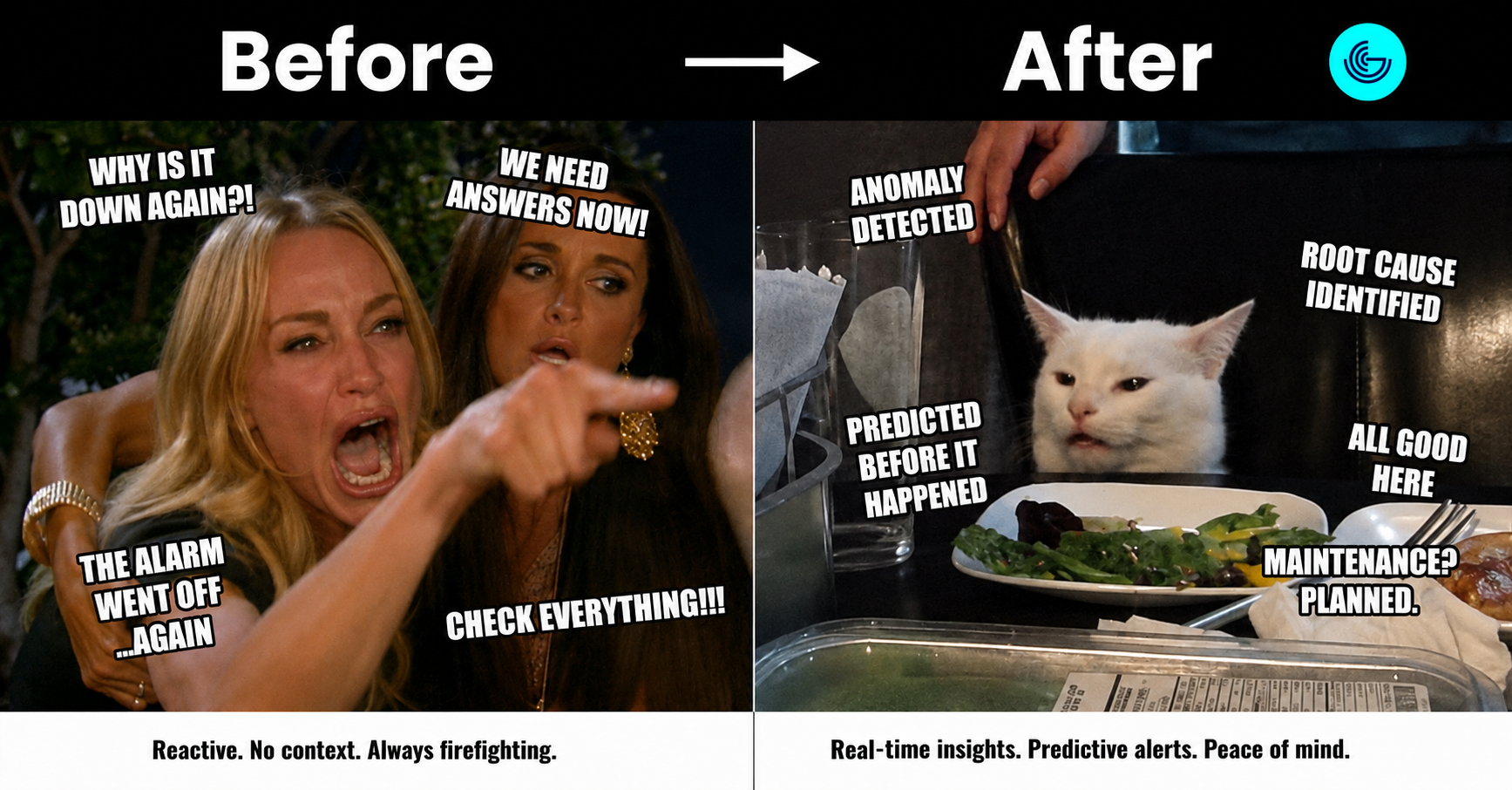
Traditional predictive maintenance sets a static limit. If a motor vibration or surface temperature crosses a predetermined level, an alarm sounds. The flaw in this approach is that it ignores operational context. Legacy systems cannot differentiate between normal asset performance shifts and actual mechanical damage, leading to massive false-alarm spikes, severe alert fatigue, and a maintenance team that eventually learns to ignore the dashboard entirely.
The Subcomponent Micro-Fingerprint
True cognitive maintenance shifts the analytical focus from ambient variables to a machine internal mechanics. Advanced AI maintenance platforms utilise Machine Behavioural Analysis powered by proprietary feature normalisation and multi-modal data fusion, integrating sound, vibration, and thermal telemetry.
Instead of measuring how loud or hot a machine is externally, the AI isolates a unique acoustic, thermal, and kinetic fingerprint at the subcomponent level, tracking micro-structural deviations inside bearings, shafts, or gear teeth independently of speed or load fluctuations.
2. Crucial Evaluation Criteria for Predictive Maintenance in Saudi Arabia
Your selection framework must filter for the operational, organisational, and structural realities of the Kingdom.
Data Sovereignty and Infrastructure Security
For critical infrastructure, defence fleets, and Tier-1 energy sectors in KSA, keeping sensitive operational data within the country borders or behind a local firewall is mandatory.
-
Cloud-only software architectures represent a major regulatory compliance risk under national cybersecurity mandates.
-
Look for solutions that support a fully on-premise deployment or hybrid, allowing real-time processing on-site without a mandatory outbound cloud round-trip.
Overcoming the Fragmented Legacy Floor
Most Saudi manufacturing facilities are a living historical map of equipment. A single production line might feature a state-of-the-art European packaging machine running right next to a decades-old, non-digitised legacy compressor from an entirely different manufacturer.
The core mission of modern cognitive maintenance is to become the system of intelligence that critical assets rely on to understand, predict, and optimise their own operations. Leaders should avoid platforms tied strictly to proprietary sensors or single-brand original equipment manufacturer (OEM) ecosystems. The right software must act as a brand-agnostic intelligence layer across your entire diverse footprint.
3. The Core Technology Audit: 3 Pillars of Model Quality
When evaluating vendor analytics, bypass the sales decks and run their software through a strict technical audit based on three core pillars:
[1. The Intelligence Engine] ──> Brand-agnostic transfer learning via massive anomaly databases.
[2. Diagnostic Precision]    ──> Root Cause Analysis (RCA) accuracy validated against real failures.
[3. Remediation Autonomy]    ──> Moves past vague alerts to deliver 100% automated repair steps.
Pillar I: Time-to-Insight (The Learning Period)
Most predictive platforms require a 3 to 6 month setup phase to collect baseline data on your machines before they can accurately spot an anomaly. During this window, you remain completely exposed to unplanned breakdowns.
Look for solutions backed by an intelligent matching and knowledge hub that leverages a brand-agnostic transfer learning engine. At the core of the Groundup.ai Cognitive Maintenance platform, there is the Groundup.ai Asset Library™, a proprietary machine intelligence engine trained on millions of tri-parameter machine health data points spanning sound, vibration, and thermal signals. This architecture eliminates the typical 3 to 6 month learning period required by competitors, delivering 10x faster time-to-insight and driving a 20x near-term ROI through immediate failure prevention across any asset brand.
Pillar II: Root Cause Analysis (RCA) Accuracy
A high anomaly detection rate means nothing if the system cannot tell you what is failing. A system that simply states Asset 04 Abnormal leaves your engineers stuck doing manual, time-consuming troubleshooting.
Demand documented maintenance failure analysis accuracy metrics. By combining signal processing, multimodal AI, and agentic reasoning, the platform transforms raw machine telemetry into operational intelligence. Advanced agentic AI employed by the GINA Autonomous Decision Engine utilises a strategic loop to autonomously select multi-modal diagnostic tools.
Pillar III: Automated Remediation Planning
The absolute ceiling of traditional industrial maintenance software is the human diagnosis gap. Cognitive platforms close this gap by automatically converting data into a complete remediation plan. As noted by Jeremy Tan, Partner at Tin Men Capital, work in Cognitive Maintenance goes beyond predicting failures to transform maintenance into a strategic asset, providing a game-changer in asset-heavy industries. Moving beyond simple alerts to provide 100 per cent automated remediation planning, the system identifies the exact root cause and necessary repair steps, detecting hidden faults, diagnosing root causes, and prescribing precise corrective actions before problems arise.
4. Digital Integration & Non-Invasive Deployment
An isolated software dashboard that sits on a screen in the control room becomes an expensive data silo. To drive a massive, near-term return on investment, predictive insights must flow directly into your plant daily workflows.
CMMS and ERP Interoperability
When the AI detects a developing subcomponent fault, such as stage-2 bearing surface fatigue, it should not just trigger a dashboard pop-up. It must pass that precise diagnostic script via API directly to your existing CMMS or ERP ecosystem. The platform should automatically draft the targeted work order, identify the necessary spare parts, and assign the task before the machine suffers secondary, cascading damage.
Non-Invasive Sensor Retrofitting
You cannot afford to shut down an active, profitable bottling or processing line just to install a heavy condition-monitoring system.
-
Avoid invasive deployment methods that require drilling into machine casings or modifying internal electrical panels.
-
Prioritise rugged, industrial IoT sensors that attach magnetically or non-invasively to equipment surfaces. These allow your team to capture high-precision vibration, temperature, and acoustic signals without a single second of production downtime during installation.
5. Industrial Procurement Checklist
Use this structured framework during vendor alignment calls.
6. Realising Industry 5.0 Outcomes
Implementing an enterprise-grade AI predictive maintenance strategy is not an experimental IT project, it is a core pillar of operational sustainability and cost control. Leon Lim emphasises that in labour-tight or rapidly evolving sectors, utilising physical AI with computing and reasoning capability reframes workforce displacement fears into empowerment, freeing workers for creative, judgment-based roles while digital models handle the tedium of potential risks.
Deployed on-premise or in the cloud, Groundup.ai supports asset-heavy industries including Manufacturing, Maritime, Defence, and Critical Infrastructure. When a facility successfully transitions from defensive, reactive firefighting to cognitive asset protection, the bottom-line metrics change immediately. World-class organisations including the Republic of Singapore Navy, Coca-Cola bottling operations, and Anglo-Eastern trust this architecture to serve customers across Southeast Asia, the GCC, developed APAC markets, and selected European regions.
The deployment of these cognitive frameworks yields highly clear, repeatable benchmarks:
-
50% Reduction in Unplanned Downtime: Eliminating catastrophic, cascading failures by addressing subcomponent wear weeks before a breakdown occurs, reducing unplanned downtime by 50 per cent.
-
80% Increase in Maintenance Efficiency: Eradicating alert fatigue and ensuring that engineering hours are spent only on assets that require verified intervention.
-
Proven Financial Impact: Preventing the structural, secondary damage that results from unaligned shafts or degraded bearings running unchecked.
By focusing your evaluation framework on subcomponent precision, true diagnostic reasoning, and a brand-agnostic intelligence engine, you ensure that your plant selects an AI platform built for absolute operational certainty.
The result is simple: eliminated unplanned downtime, extended asset lifespan, and measurable ROI.
Success Story: Coca-Cola Saudi Arabia
When one of the world’s largest beverage producers faced potential failures across 12 production lines, the stakes were high. Any unplanned stoppage would ripple across their entire supply chain.

Frequently Asked Questions (FAQs)
What is the best predictive maintenance software in Saudi Arabia?
The best software for Saudi Arabia is an OEM-agnostic cognitive maintenance platform that supports fully on-premise deployment to comply with local data sovereignty laws. It must utilise multi-modal data fusion to filter out ambient industrial factory noise, ensuring a zero false alarm rate on the factory floor.
Can AI maintenance platforms deploy in air-gapped networks?
Yes. Enterprise-grade industrial solutions offer native on-premise deployment architectures designed specifically for secure, air-gapped infrastructure, defence sectors, and petrochemical facilities where external cloud connectivity is restricted.
How does cognitive maintenance improve work efficiency?
By identifying specific internal component anomalies instead of broad machine errors, the engineering team receives exact root-cause data. This increases frontline maintenance efficiency by up to 80 per cent because mechanics know exactly what tool and replacement subcomponent to bring to the machine.
Zero downtime. Zero guesses. Zero waste.