There is an uncomfortable truth most AI maintenance vendors do not put in their pitch decks.
Traditional predictive maintenance is broken. Not underperforming, broken. The tools that defined the category spent a decade promising operations leaders they could prevent failures by flagging anomalies. What they actually delivered was dashboards full of alerts, engineers buried in false positives, and maintenance teams permanently stuck in the same firefighting cycle the technology was supposed to end.
“We’re not just optimizing maintenance—we’re changing how industries operate,” says Leon Lim, CEO and Founder of Groundup.ai to AsiaTechDaily.
Our platform empowers maintenance teams to make assets intelligent, self-monitoring, and capable of predicting failures before they happen.
Industry 5.0 is moving past this. The leaders managing packaging lines in Jakarta, maritime fleets in the Singapore Strait, and heavy asset facilities across the GCC are no longer asking which predictive maintenance software to buy. They are embracing the next structural milestone: Physical AI and Cognitive Maintenance.
They are asking a different question entirely: which platform can reason, diagnose, and tell my team exactly what to do, before anything fails?
This is the buyer’s guide that answers that question.
Key Takeaways: The New Industrial Standard
- Eradicate Onboarding Delays: Traditional platforms require a 3-to-6-month raw data runway. True cognitive networks leverage global transfer learning to protect machinery on day one.
- Isolate Subcomponent Fingerprints: To permanently stop false alarms, software must look past general ambient parameters (like ambient temperature or surrounding crosstalk) to extract the unique micro-structural behavior inside the machine.
- Insist on Agentic Autonomous Systems: An alert that reads “Asset 04 Abnormal” is a text liability. The future relies on autonomous strategic loops that deliver a 94% diagnostic accuracy (RCA) and 100% automated remediation planning.
- Prioritize Deployment Versatility: Ensure your vendor can deliver a fully on-premise, secure architecture alongside cloud options for scalable multi-site tracking.
Why Is Traditional Predictive Maintenance No Longer Sufficient?
Traditional predictive maintenance tools were built on a straightforward premise: collect sensor data, identify when values deviate from a baseline, generate an alert. The logic was sound. The execution produced something most operations leaders now recognise as a problem rather than a solution.
The Problem with Vague Alerts
“High vibration on Compressor 3” or “Thermal deviation on Pump B” tells an engineer very little. They do not reveal what is failing or how to repair it. The technician must still halt operations, open the asset, and manually diagnose the root cause, the exact investigative barrier the AI was supposed to destroy.
The Financial Strain of False Positives
Legacy systems cannot distinguish between a machine running hot under a heavy, normal production load and a machine running hot because a bearing is actively failing. To a fixed threshold, both look identical. Over time, this threshold trap causes severe alert fatigue. Your frontline operators quickly learn to mute the dashboard, meaning that when a genuine, catastrophic failure actually develops, it gets completely buried in the noise.
The Prohibitive Data Runway
Older platforms are trained strictly on historical failure data. They literally require your physical machines to fail, repeatedly, to map out a baseline model. For most modern hubs, that data either doesn’t exist in clean form or requires a 3-to-6-month validation window that completely delays your return on investment.
What Is the Difference Between Predictive Maintenance and Cognitive Maintenance?
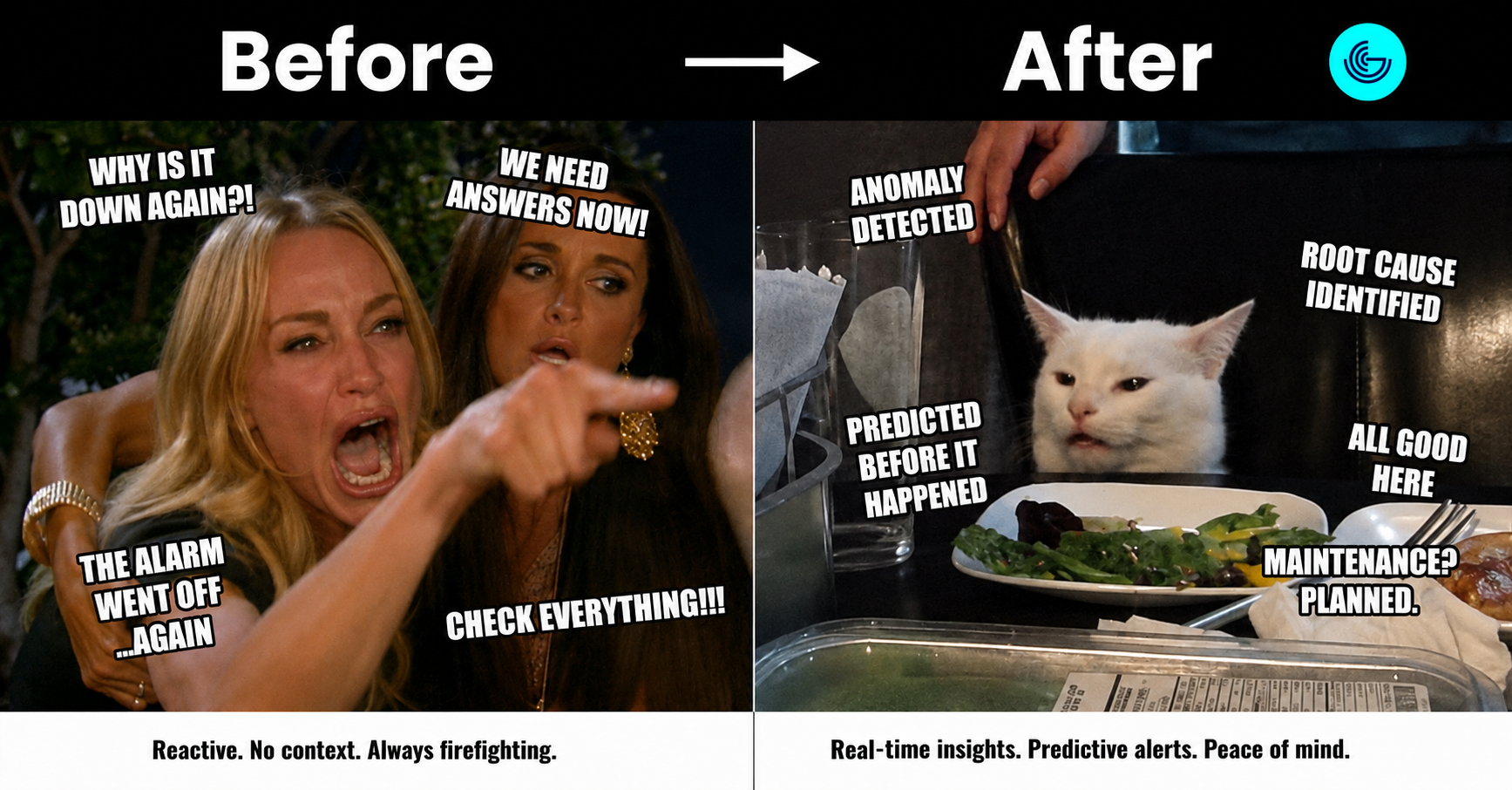
Predictive maintenance detects that something may be wrong. Cognitive Maintenance determines what is wrong, why it is wrong, and what to do about it.
The distinction sounds incremental. In practice it is structural, the difference between a warning light and a diagnosis.
A predictive maintenance alert: “Asset 04: High Vibration.”
A Cognitive Maintenance diagnosis: “Asset 04 is exhibiting early-stage inner-race bearing wear consistent with lubrication starvation. Schedule a replacement within 14 days and verify lubrication alignment before the next shift.”
As Jeremy Tan, Partner at Tin Men Capital, puts it:
Work in Cognitive Maintenance goes beyond predicting failures. It transforms maintenance into a strategic asset—a game-changer in asset-heavy industries.
By deploying an autonomous system of intelligence, the investigation phase is entirely eliminated. Faults are resolved during short, planned maintenance windows rather than chaotic emergency shutdowns, completely protecting secondary components from cascading damage.
What Should You Look for When Evaluating an AI Maintenance Platform?
Choosing an industrial AI maintenance platform is a multi-year operational decision. The evaluation criteria that matter are not the ones that appear most prominently in vendor marketing, accuracy percentages, sensor counts, dashboard feature lists. The criteria that matter are the ones that determine whether the platform actually changes how your operation runs.
Does It Work Without a Long Data Runway?
The most significant barrier in legacy predictive maintenance deployment is the data requirement. Traditional platforms need historical failure data to train their models, which means they need your machines to fail, repeatedly, before they can reliably predict failure. For most facilities, that runway takes 3 to 6 months at minimum, and the data quality is rarely clean enough to produce reliable models even then.
A platform built on transfer learning and a pre-trained asset library eliminates this requirement. Models trained on thousands of real-world industrial machine signatures across global deployments recognise failure patterns from day one, without needing your specific machine to fail first. Baseline behaviour for each asset is established within 2 to 3 weeks of deployment.
If a vendor requires more than 4 weeks before delivering useful insights, that requirement is a design limitation, not a technical necessity.
Does It Focus on Subcomponent-Level Diagnostics?
Most sensor-based maintenance systems measure ambient parameters, overall temperature, overall vibration, pressure. These are useful signals but they are lagging indicators. By the time an ambient parameter crosses a meaningful threshold, the fault has already developed to a physically detectable level.
True cognitive intelligence tracks micro-structural deviations inside specific components: inner race bearing wear, shaft misalignment developing at the coupling, lubrication breakdown at the gear mesh, rather than surface-level readings.
The question to ask any vendor: can your platform tell me which specific subcomponent is developing a fault, or does it tell me which asset is behaving abnormally? The first is a diagnosis. The second is an alert.
Does It Deliver Agentic Root Cause Analysis?
An alert without a diagnosis is an expensive noise generator. The platform you choose must deliver automated root cause analysis as a core output, not as a premium feature or a manual analyst service.
Agentic AI diagnostics means the system autonomously performs the investigation step: correlating data across multiple parameters, filtering environmental and operational variables, matching anomaly signatures against a library of known failure modes, and producing a specific conclusion about what is failing and why.
The output must be actionable without interpretation. “Asset 04: High Vibration” requires a skilled engineer to interpret. “Asset 04 is exhibiting early-stage inner-race bearing wear. Schedule replacement within 14 days” can be acted on by any trained technician. The difference determines whether your maintenance team is executing or investigating.
Can It Deploy Without Disrupting Your Operation?
The deployment model is as important as the technology. A platform that requires significant infrastructure changes, extended integration work, or operational downtime to install creates the very disruption it is supposed to prevent.
The standard to insist on: wireless sensors that retrofit onto active machinery, with no modification to existing SCADA systems, OEM monitoring tools, or digital infrastructure. The system should sit above existing data sources, unifying their outputs, rather than replacing them.
This is particularly critical for facilities with mixed asset ages, multiple OEMs, and legacy infrastructure. The platform must be able to monitor a 20-year-old compressor on the same network as a brand-new turbine without requiring either to be reconfigured.
Does It Support Both On-Premise and Cloud Deployment?
Industrial facilities operate under a wide range of connectivity and security constraints. Facilities in regulated sectors, defence, critical infrastructure, secure government facilities, require fully on-premise deployment with no external data transmission. Multi-site operations require cloud-scale aggregation across facilities.
A platform that supports only one deployment model is a platform that cannot serve the full range of industrial environments. Insist on flexibility: fully on-premise or cloud for scalable multi-site visibility, and edge computing for remote or low-connectivity environments. The deployment model should fit the operation, not the other way around.
What Questions Should You Ask an AI Maintenance Vendor?
Before committing to any platform, these questions separate genuine cognitive intelligence from legacy predictive tools with better marketing.
- How long before we receive actionable insights? Anything beyond 4 weeks indicates a platform reliant on historical failure data rather than transfer learning. Push for a specific timeline, not a range.
- What is your false positive rate in active industrial deployments? Vendors with context-aware, dynamic baselines have measurable false positive rates. Vendors relying on static thresholds will struggle to answer this question specifically.
- Can you show us a sample diagnostic output? Ask for a real example from a live deployment, not a demo environment. The output should name a specific fault, identify the root cause, and prescribe a specific action with a timeframe.
- What does deployment look like for brownfield equipment? Most industrial facilities have mixed asset ages and OEMs. Deployment must be non-invasive, sensor-based, and infrastructure-independent. Any answer involving significant integration work is a red flag.
Frequently Asked Questions: Choosing an AI Maintenance Platform
What is the difference between a predictive maintenance platform and a cognitive maintenance platform? Predictive maintenance platforms detect anomalies and generate alerts. Cognitive maintenance platforms detect anomalies, diagnose root causes through automated analysis, and deliver specific prescriptive repair guidance, eliminating the human investigation step between alert and action. The functional difference is the difference between a warning and a diagnosis.
How long does it take to deploy an AI maintenance platform in an active facility? With wireless sensor deployment and transfer learning models, active monitoring can begin within hours of sensor installation. Reliable asset health baselines are established within 2 to 3 weeks. No operational downtime is required for installation and no existing infrastructure needs to be replaced or reconfigured.
What causes false positives in predictive maintenance systems and how do you avoid them? False positives in predictive maintenance are caused by static threshold alerting that cannot distinguish between genuine mechanical faults and normal operational variation. Load changes, ambient temperature fluctuation, production speed variation. Context-aware AI that establishes dynamic baselines for each specific asset under its specific operating conditions eliminates the vast majority of false positives.
Do AI maintenance platforms work on old or legacy industrial equipment? Yes, provided the platform is designed for brownfield deployment. Wireless sensors that retrofit onto any asset regardless of age, brand, or OEM, combined with pre-trained models, make legacy equipment compatible with modern cognitive maintenance. The asset age is not the constraint. The deployment model is.
What data does an AI maintenance platform need to start delivering value? A platform built on transfer learning and a pre-trained asset library does not require historical failure data to begin delivering value. It learns normal behaviour for each specific asset from live operational data, typically within 2 to 3 weeks. Historical data improves model accuracy over time but is not a prerequisite for deployment.
How do you calculate ROI for an AI maintenance platform? ROI calculation should include: fully loaded cost of current unplanned downtime hours (not just direct repair costs), emergency procurement premium, repeat failure costs from incomplete root cause analysis, and the scaling risk of growing production on unmonitored assets. Most industrial facilities with meaningful reactive maintenance exposure see payback within 12 months of deployment.
What is Physical AI in industrial maintenance? Physical AI refers to artificial intelligence systems that understand the physics of the machines they monitor, not just the statistical patterns in their sensor data. Where legacy predictive tools detect deviations from historical baselines, Physical AI reasons about the mechanical, thermal, and acoustic behaviour of specific components under specific operating conditions. This is what enables subcomponent-level diagnostics and genuine root cause analysis rather than threshold-triggered alerts.
The industrial maintenance landscape is dividing. On one side, operations that have moved from anomaly detection to cognitive intelligence, where every alert arrives with a diagnosis and every maintenance intervention is planned rather than reactive. On the other, operations are still absorbing the cost of the next failure they did not see coming.
The technology to make that transition is deployable today, in weeks, on the equipment you already have with Groundup.ai. ⚡️