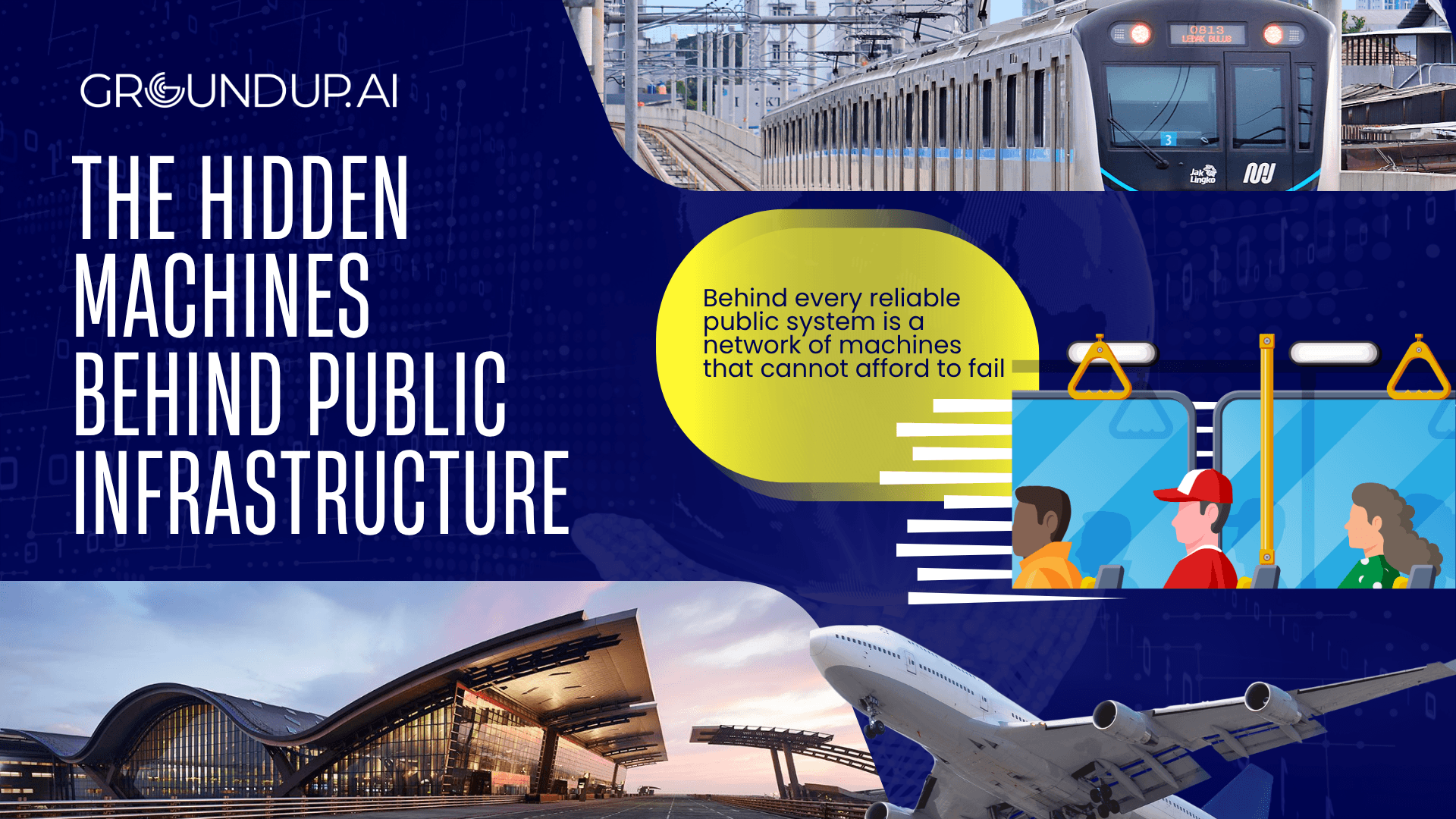
You step onto a cooled metro platform after a long day. The air is perfectly tempered. The escalators glide. Your baggage moves seamlessly behind the scenes.
You don’t think about the machines. You shouldn’t have to.
In public infrastructure, a machine’s ultimate success is measured by its invisibility. The moment you notice it is almost always the moment something has gone wrong.
Behind every reliable public system is a hidden network of machinery operating under relentless pressure. 24 hours a day, 7 days a week, with zero tolerance for failure. For the engineers and operators tasked with keeping these assets invisible, maintaining that silence is one of the highest-stakes balancing acts in industrial operations.
To understand what it actually takes, we went deep into some of the world’s most demanding infrastructure environments: the stations of Doha Metro to the sprawling aviation gateways of an international airport.
Here is what those deployments taught us about machine health, and why most AI maintenance tools are not built for this reality.
What Is the Black Box Problem in Predictive Maintenance?
The Black Box problem refers to the gap between a predictive maintenance alert and a usable diagnosis.
A traditional predictive tool flags a critical asset with high vibration. It tells you something is wrong. It does not tell you why, where in the asset the fault is developing, or what your maintenance team should do about it. In a fast-moving public environment, this produces alarm fatigue, engineers drowning in alerts they cannot take action on, unsure which warnings are urgent and which are noise.
The consequences in public infrastructure are not abstract. At Doha Metro, thousands of daily commuters depend on automated Air Handling Units to keep subterranean stations breathable. When GINA, Groundup’s AI agent, detected severe, intermittent vibration spikes on one of these units, it did not simply raise an alert.
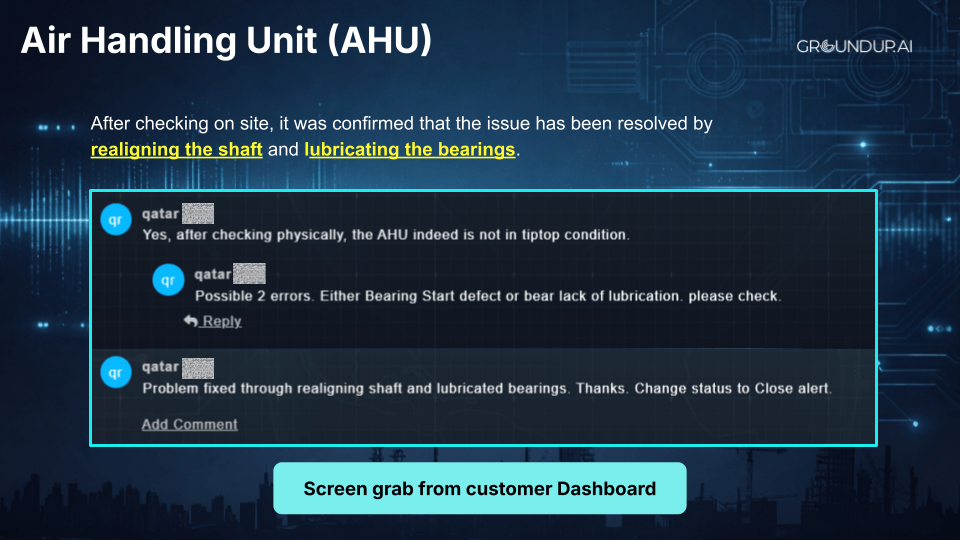
GINA’s agentic diagnostic logic identified Bearing Surface Fatigue occurring specifically during the unit’s start-up phase. Not a general anomaly! A specific fault, a specific component, a specific operational moment, converted into a targeted 15-minute maintenance task, completed before any commuter noticed a disruption.
This is what separates explanatory diagnostics from standard predictive alerting. The goal is not to flag problems faster. It is to eliminate the investigation step entirely by arriving with the answer already attached. This is Cognitive Maintenance.
Why Does Environmental Context Matter So Much for Machine Health AI?
Standard AI maintenance tools are calibrated for controlled environments. They apply uniform thresholds and assume consistent operating conditions. In real-world critical infrastructure, this assumption fails consistently.
Consider the difference between a machine running on a climate-controlled factory floor and that same machine bolted to a heavy maintenance vehicle roaring through a desert corridor. Standard software treats these as equivalent. The physical reality is completely different.
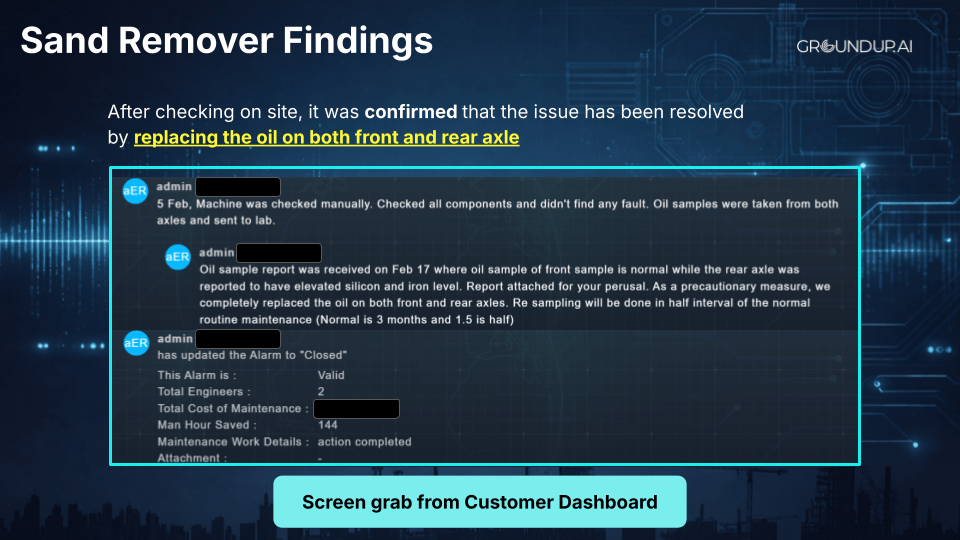
Etihad Rail’s heavy sandfighter vehicles operate across harsh desert conditions, clearing massive sand drifts to maintain national transit stability. When Groundup.ai’s sensors captured matching 4.71 Hz destructive impact patterns across dual differential gearboxes on these vehicles, the diagnosis was not generic wear. It was acute lubrication distress driven by fine sand ingress, identified weeks before physical gears could strip or seize.
The machine health signal was the same. The context that gave it meaning was entirely environment-specific.
This is why effective industrial AI must adapt dynamically to:
- Geography and climate: Desert sand ingress, coastal humidity, and subzero temperatures produce completely different failure signatures on identical equipment. A model trained in one environment cannot be applied wholesale to another.
- Operational load profiles: A transit vehicle running on-schedule service has a different stress pattern than one operating in emergency mode. AI that does not account for shifting operational context produces false positives that erode operator trust.
- Asset age and condition baseline: A new gearbox and a ten-year-old gearbox running the same route have different normal ranges. Meaningful diagnostics require a baseline calibrated to the specific asset, not the asset class.
Machine health cannot be evaluated in a vacuum. Protecting critical infrastructure requires AI that reads the environment as fluently as it reads the sensor data.
What Are the Deployment Constraints That Most Maintenance AI Ignores?
The technical capability of a maintenance AI platform means nothing if it cannot be deployed without disrupting the operation it is meant to protect.
This is the constraint that most vendors underestimate, and the one that public infrastructure operators encounter immediately.
Telling an airport director that you need to halt primary cooling loops or baggage systems to install a monitoring solution is an immediate no-go. Operators running 24/7 public schedules will reject any technology that introduces installation downtime, operational friction, or steep learning curves for frontline staff. The technology may be excellent. The deployment model makes it irrelevant.
At international airports, the world’s busiest aviation hubs, operations never sleep. There is no maintenance window. There is no low-traffic period that can absorb a system integration outage. Any monitoring solution must integrate without interruption, configure without specialist installation teams, and deliver value without months of onboarding.
The answer is non-invasive hardware architecture. Wireless, magnetic IoT sensors that attach to active machinery in minutes, no need for a shutdown, no rewiring, and no delay.
That, combined with AI that begins learning from live data immediately rather than requiring months of historical failure data, is what near zero-friction deployment looks like in practice.
The principle applies beyond airports:
Critical infrastructure — utilities, water treatment, rail networks, maritime vessels, they share the same deployment constraint. The tech must fit the operation. The operation cannot be paused to fit the tech.
This is not a minor implementation detail. It is the difference between a pilot that proves value and a deployment that never gets off the ground.
What Does Cognitive Maintenance Deliver in Mission-Critical Infrastructure?
Cognitive Maintenance is the operational outcome of combining explanatory diagnostics, context-aware AI, and near zero-friction deployment in a single integrated platform.
It is not a marginal improvement on predictive maintenance. It is a different category of capability. One that addresses the three failure modes that predictive maintenance leaves unresolved: the black box problem, the context blindness problem, and the deployment friction problem.
The results in mission-critical infrastructure environments are measurable. Groundup.ai has secured 22 consecutive months of zero unplanned downtime for a specific client operating within critical infrastructure. Not only through better prediction, but through earlier, more accurate diagnosis combined with faster, more confident operator response.
The distinction matters:
Predictive maintenance reduces the frequency of surprise failures. Cognitive Maintenance eliminates the investigation lag between alert and action, increases the proportion of faults that are fully resolved rather than temporarily managed, and builds the operational trust that enables maintenance teams to act on AI recommendations with confidence rather than scepticism.
In public infrastructure, where the cost of failure is measured in public disruption, safety risk, and regulatory consequence rather than just production loss, that distinction is significant.
Frequently Asked Questions: Machine Health in Critical Infrastructure
What makes critical infrastructure maintenance different from standard industrial maintenance? The primary difference is consequence. In manufacturing, an unplanned failure costs production throughput and repair spend. In critical infrastructure — transit, airports, utilities, maritime — an unplanned failure affects public safety, regulatory compliance, and service continuity for thousands of people simultaneously. The tolerance for failure is effectively zero, which raises the requirement for maintenance AI from useful to essential.
Why do standard predictive maintenance tools fail in public infrastructure environments? Three reasons: alarm fatigue from non-explanatory alerts, context blindness that applies uniform thresholds regardless of environment, and deployment models that require operational downtime to install. Public infrastructure cannot pause for any of these.
How long does it take to deploy Cognitive Maintenance in an active infrastructure environment? With wireless IoT sensors and a zero-friction deployment model, active monitoring can begin within hours of sensor attachment. Baseline model development occurs from live operational data, eliminating the months-long historical data requirement of traditional predictive maintenance systems.
What is the difference between a predictive alert and an explanatory diagnosis? A predictive alert tells you a fault is developing. An explanatory diagnosis tells you which fault, why it is occurring, where in the asset it is located, and what your team should do about it. In infrastructure environments where response time matters, the difference between the two is the difference between managed risk and eliminated risk.
How does Groundup.ai handle the diversity of assets in complex infrastructure environments? Through environment-adaptive AI and a continuously expanding Asset Library of proprietary anomaly signatures. Each new deployment contributes to the library, improving diagnostic accuracy across asset types and operating environments. This is what makes the platform more accurate in a Jakarta metro station than a generic model trained on manufacturer specifications.
The machines powering your daily life, the AHUs keeping metro stations breathable, the cooling systems maintaining airport terminals, the gearboxes keeping desert rail lines clear, succeed when you never think about them.
Keeping them invisible is the work. ⚡️
What are the biggest maintenance blind spots your team is facing with hidden or mission-critical assets?